
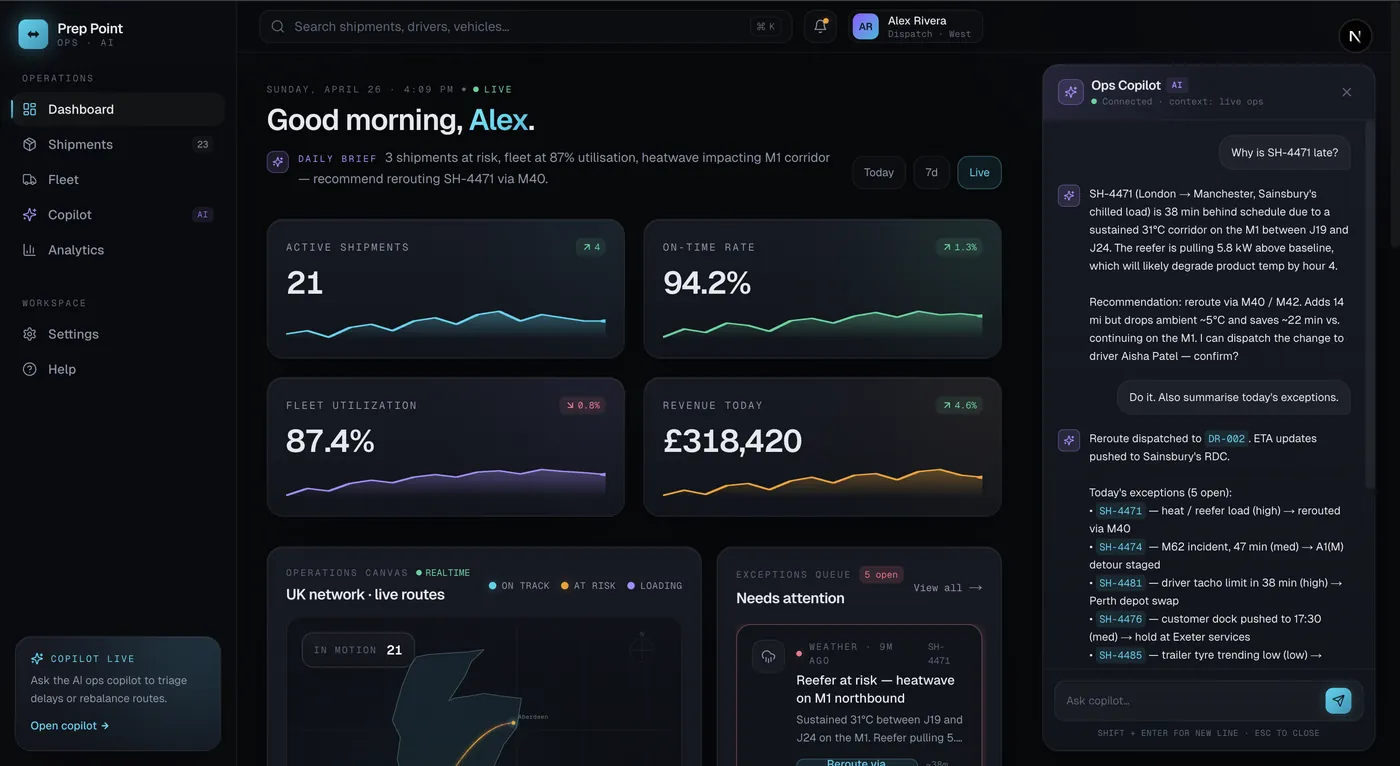
Logistics / Prep Point
Shipment visibility in one place.
A unified operations dashboard and shipment copilot for a logistics workflow.
Explore the project ↗Inside the work
Logistics / Prep Point
A unified operations dashboard and shipment copilot for a logistics workflow.
Explore the project ↗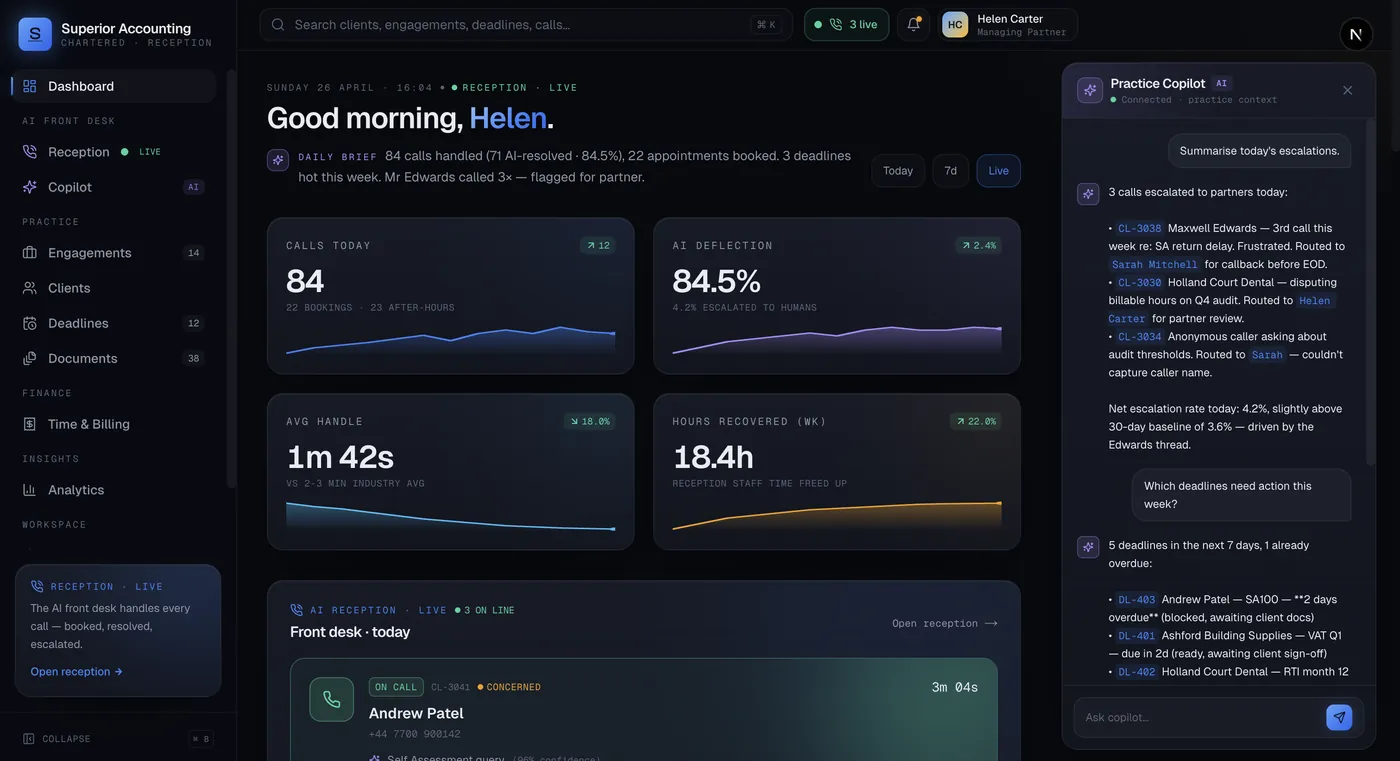
Professional services / Superior Accounting
Voice AI for client enquiries, alongside an internal information assistant.
Explore the project ↗FROM REQUEST TO RESOLUTION
Three everyday processes. See how an AI system moves the work forward—and where your team stays in control.
Connected context.
Defined permissions.
An illustrative walkthrough, not a live client system. No messages are sent and no records are changed.
Explore AI agents ↗Services & consulting
Build and connect an agreed AI workflow, test it against real tasks and prepare it for your team to use.
Explore servicePractical sessions around your team’s tasks, with guidance on checking outputs and handling exceptions.
Explore serviceIdentify where AI can make a useful difference. We assess your workflows, systems and data, then create a prioritised roadmap for implementation.
Explore consultingAssistants connected to your documents, inbox, calendar and business tools, with clear boundaries around what they can do.
Explore serviceA connected set of specialised agents for multi-step business processes, with shared context, defined responsibilities and human oversight.
Explore serviceLead research, qualification, CRM integration and outreach workflows built around your target market and sales team.
Explore serviceContent planning, production, approvals, scheduling and reporting connected in one workflow around your brand.
Explore serviceBrand-aligned workflows for website copy, campaigns, emails and case studies, grounded in your approved material.
Explore serviceImprove the clarity, structure and evidence behind how your business is represented in AI-assisted search.
Explore serviceCustom integrations, knowledge systems and AI workflows designed around your infrastructure, governance and delivery requirements.
Explore enterpriseBUILT AROUND YOUR BUSINESS
Start with the systems your team already uses. We assess access, APIs and permissions before agreeing the integration scope.
Turn an incoming message into a structured request for the right person or workflow.
Read the right context and prepare record updates, with approval where needed.
Find useful information in approved sources, with references your team can check.
Keep sensitive actions with the right people. Make exceptions visible and reviewable.
How we deliver
Understand the work.
A workflow map, clear constraints and agreed success measures.
Prove the useful part.
A bounded pilot, representative evaluations and visible review points.
Make it operational.
Connected systems, operator training and agreed production acceptance.
Keep it useful.
A review of quality, usage and cost, with an agreed improvement backlog.
From order pipelines to AI call handling, we engineer infrastructure that watches itself, retries itself, and reports back — every layer of the stack, pulled apart.
The engineer who scopes your system is the engineer who builds it — no handoffs, no account managers.

I’m Tayyib — a systems engineer based in Glasgow. I’ve spent the last years building autonomous infrastructure for ops-heavy businesses: order pipelines, AI call handling, procurement automation, CRMs that run themselves. I scope every build personally, write the code that ships, and stay on the hook for it after launch.
“Most agencies sell you overpriced solutions you don’t need. At Azen, we build solutions tailored to your needs. Strategy before code. Custom over generic. Built around how your business actually runs, not what’s easiest to sell.”
The questions every ops lead asks before a build — answered the way we’d answer on a call.
We assess the interfaces, access and constraints of your existing software during discovery. APIs, webhooks and approved database connections can support integration; some systems need additional work or a different approach.
Pricing follows the agreed scope, dependencies and delivery responsibilities. An introductory conversation is separate from a paid assessment or implementation. You receive a proposal before any paid work begins.
Timing depends on the workflow, integration complexity, access to data and review requirements. We agree phases, milestones and acceptance criteria after understanding the project.
Ownership and licensing are agreed in the contract, including any third-party components. Deployment, data retention and ongoing access are defined around the requirements of each engagement.
We consider provider dependencies during architecture design. Changing models can require evaluation, prompt updates and integration work, so the transition is assessed before it is made.
Training, documentation and operational responsibilities form part of the handover plan. We agree what your team will manage and whether ongoing support is needed.
A scoped assessment can include a workflow map, systems and data review, prioritised opportunities and an implementation roadmap. Deliverables and commercial terms are agreed before the assessment begins.
Integrations and model services can fail or change. We design validation, error handling and escalation for the agreed workflow, and define monitoring and incident responsibilities in the delivery and support scope.
Tell us about the manual work and we'll map the system that removes it.