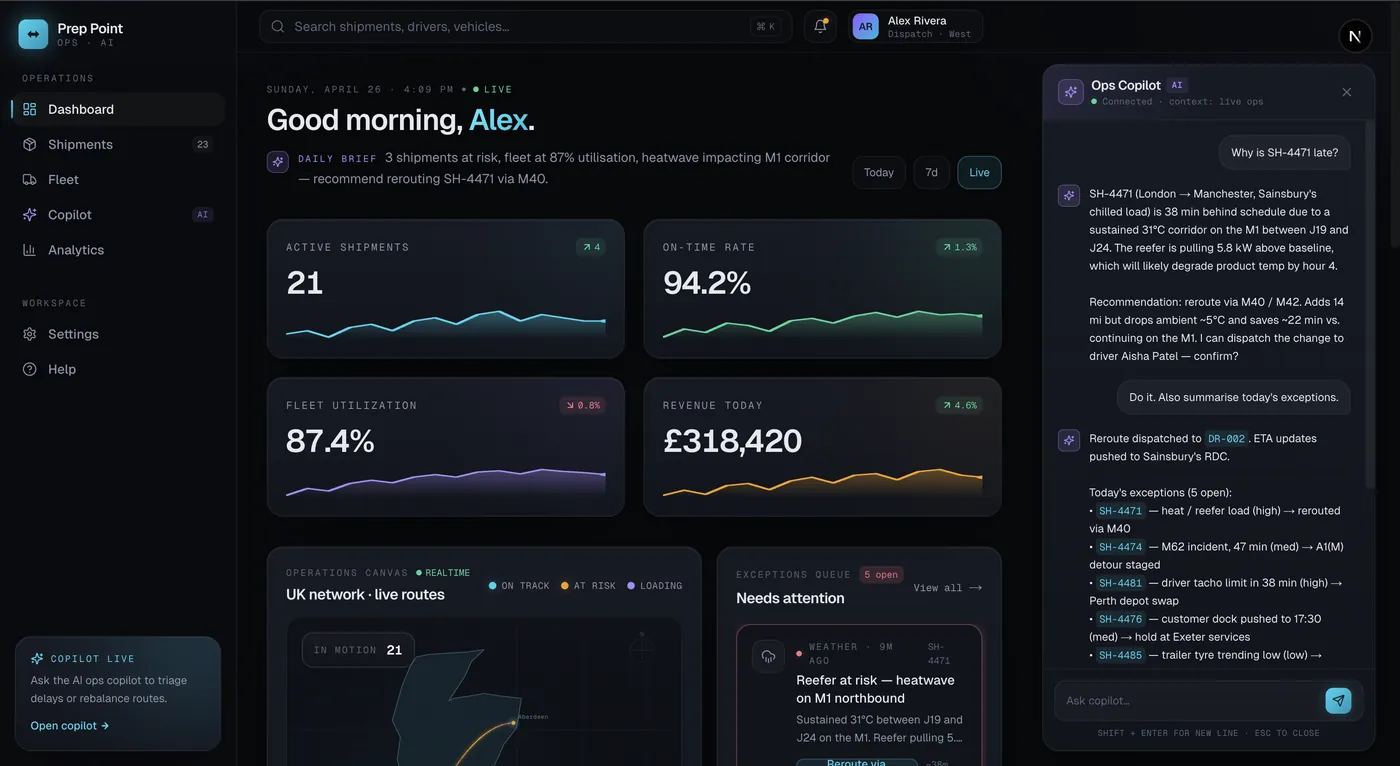
Deploying a unified AI infrastructure and specialized copilot for a high-volume 3PL logistics provider to autonomously track and orchestrate global shipments.
The logistics company was bottlenecked on disconnected legacy platforms for shipment tracking, warehouse inventory, and fulfillment data. Internal staff spent [REPLACE: hours/week] navigating manual tracking loops, with severe latency when answering complex shipping queries from clients.
Discovery mapped every manual workflow across the operations team and ranked them by hours bled per week versus integration risk. The top three workflows accounted for [REPLACE: % of total manual labour], and all three touched the same legacy WMS via webhook. That convergence determined the build sequence.
An end-to-end AI operating system. A unified dashboard consolidates fragmented shipping and tracking metrics; a domain-specific copilot tracks freight autonomously and surfaces exceptions before they escalate. Internal staff query the logistics matrix in natural language.
[REPLACE: e.g. Claude Sonnet 4.6 for reasoning, Haiku for routing, fallback to GPT-4o]
[REPLACE: e.g. Webhook bridge into legacy WMS, Stripe, EDI freight feed]
[REPLACE: e.g. Client AWS account, Postgres + pgvector, Vercel edge]
[REPLACE: e.g. Provider-agnostic adapter, queue + alert on third retry]
[REPLACE: Honest one-paragraph account of the failure mode hit during build — the integration that didn't work the first time, the prompt that hallucinated, the retry storm we saw in week two, what we changed.]
[REPLACE: One paragraph on the timeline and key decisions — when the audit shipped, when phase 1 went live, when the copilot took over and human review stopped.]
[REPLACE: Methodology paragraph — how the 85% was measured, over what window, what counts as an "error", what doesn't. Anyone reading this should be able to reproduce the calculation.]
[REPLACE: Two or three sentences on what generalises beyond Prep Point — the architectural choice or audit pattern we now apply to every new build.]
Book a free audit. We'll map yours the same way.